Reading time: 4 minutes
The genesis of a project
In February 2023, the Functional Genomics of Phytopathogenic Fungi team, where I was pursuing my Ph.D., was contacted by the Musée des Confluences. The Lyon-based (France) science center and anthropology museum wanted to create a pop-culture-based event for the ‘Fête de la Science’ 2023. ‘Fête de la Science’, which can be translated as the celebration of Science, is a national event whose primary focus is to break the barrier separating scientists and researchers from the general public. The museum’s idea was to invite speakers for open lectures and/or create small thematic exhibitions both exploring the Science featured in comics, movies, and video games such as the Jurassic Park franchise. Our team working on fungi was invited to propose something related to the ‘The Last of Us’ series and video games. Having always been interested in the artistic direction of pop-culture works and exploring diverse artistic practices outside my professional activities, I was delighted when the laboratory offered me to take charge of this collaboration.
Early in the discussion, the museum proposed a two-part intervention: the production of a workshop accessible to all ages and primarily destined for families and a lecture with more visual references to TLAU destined for a more mature public (aged 16 and over).

3D animated version of the Musée des Confluences logo created to mimic the development of mycelium. Created using Blender for the lecture. All rights reserved to Adrien Hamandjian, 2023
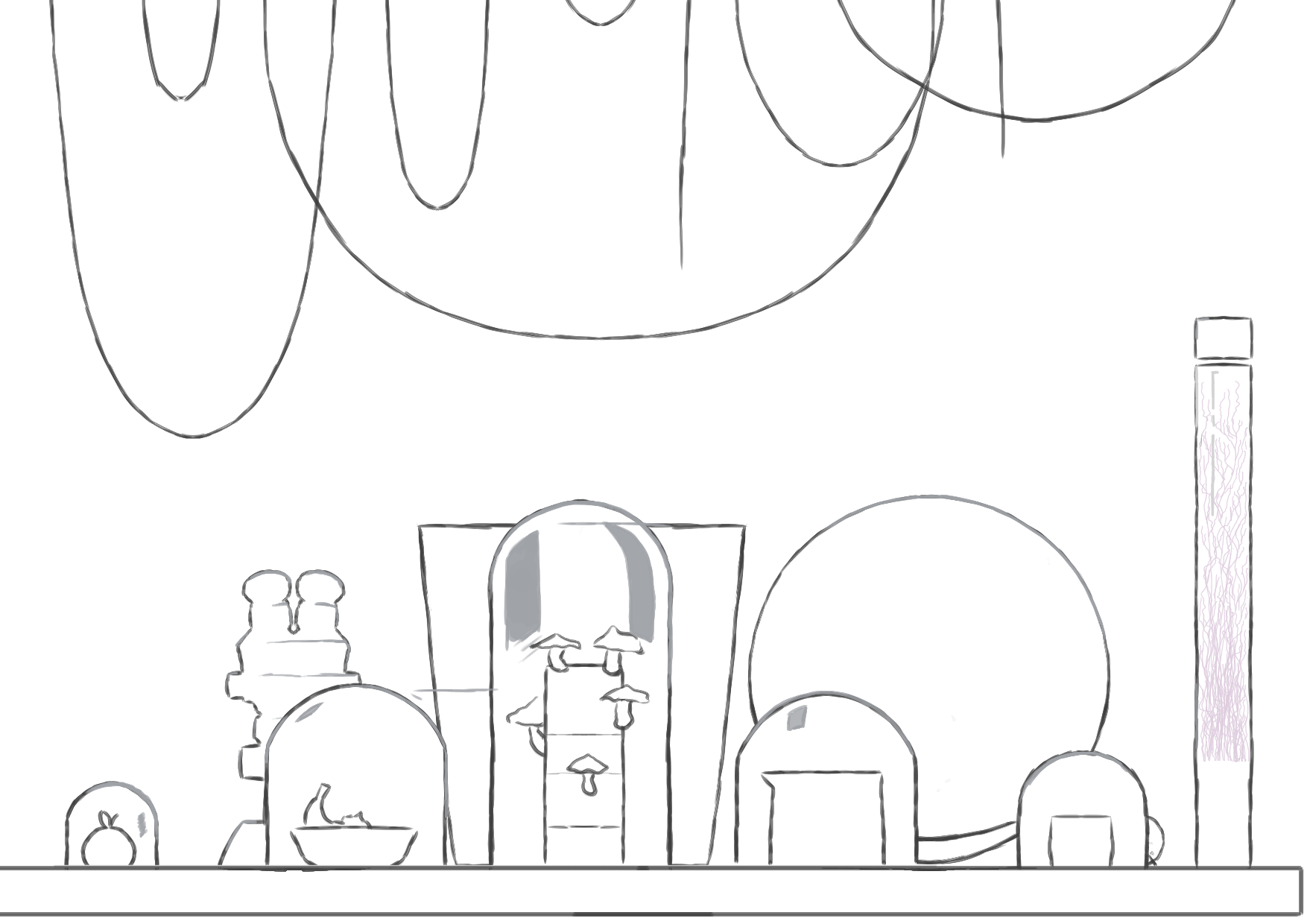
Original draft for the visual of the workshop, Adrien H
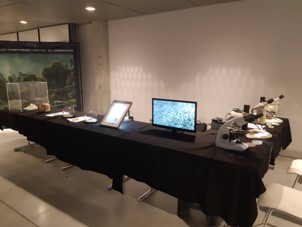
The workshop before the opening of the event. From left to right, the large box contains the 3D printing of the city’s historic district, the pink dome is a culture of Pleurotus djamor, two next globes contain culture of Mucor sp. and Purpureocillium sp. over 3D prints of the Basilica of Notre Dame of Fourvière, large lightened frame contain Petri dishes with radial growth of mycelium from various fungi, the screen displayed a movie created by the laboratory for a previous Fête de la Science event, the binocular magnifier on the right were used to observe culture of various fungi
The workshop
The specifications for the workshop were pretty straightforward: it had to be held over the two days of the event and be accessible and adapted to a large audience.
We decided to utilize striking visual displays instead of traditional posters to create an engaging workshop that remains appealing even without instructors or for attendees not seeking detailed explanations.
For the public, the word ‘fungi’ is most often associated with fruiting bodies and not their mycelium. The first item we came up with was a bedding block on which grew a pink oyster mushroom under a glass globe. This item allowed the development of both easily recognizable fruiting bodies and visible mycelium developing over the bedding visually connecting the easily recognizable fruiting body to the underground filaments.
The second item was a frame holding different Petri dishes with radial mycelium development (from a central plug), with lightning from below allowing the observation of the mycelium and its filamentous nature.
The third item was one of the most sticking for the viewer, a 3D map of the historical city district on which grew different filamentous fungi to visually represent their ability to explore their environment and keep in touch with the TLOU esthetic. In addition to the city district, we displayed a globe containing a 3D print of the Basilica of Notre Dame of Fourvière, an iconic city building, surrounded by a culture of mucor species. The production of aerial mycelium by mucor species led to the obtention of a dreamy scenery evolving as the melanization of sporangiophore heads darkened.
Lastly, binocular magnifiers were accessible to observe mycelial cultures.
The workshop, therefore, allowed the presentation of fungi and their complexity, starting from the well-recognizable fruiting bodies to the mysterious mycelium and then to the complexity and diversity of mycelial structures at the macroscopic and microscopic scales.
The lecture
In addition to the workshop, I was in charge of producing a lecture for a public of 16 and older. The lecture had to use and explore the Science behind elements of the TLAU series and video games. We came up with a presentation whose backbone followed fungi’s beneficial and detrimental impact on our society. First, we re-introduced the mycelium to the viewer and its function in fungal biology, highlighting fungi’s diversity and adaptability to terrestrial biomes. We then presented the sexual reproduction cycle in fungi, introducing the viewer to the large diversity of fruiting bodies. The cycle of fungal reproduction was then compared to the images vehiculated by the TLAU and, notably, how the fungus spread in the series. This comparison allowed us to explore how Science inspired the visuals, artistic direction, and story of TLAU.
Then, the TLAU undead allowed the introduction of fungi as potential threats due to their ability to colonize plant and animal tissues. Keeping with the undead aesthetic and life cycle in TLAU, we introduced a simplified Ophiocordiceps life cycle. This allowed the further development of visually less striking infections but all the more critical human infections by fungal pathogens, emphasizing on Aspergillus fumigatus. From A. fumigatus, we introduced the WHO fungal priority pathogens list.
While sensitizing the public to the increasing health issue surrounding fungal infection is pivotal, notably in such events targetting a broad audience, we also wanted to emphasize the beneficial applications of fungi, notably in industrial settings. From drug production and discovery to waste management and bio-remediation to pigment production, examples were illustrated to display a continuum of fungi’s past, current, and future use.
From the beginning of our interactions with the museum, it was clear that the lecture should be a discussion time, even more than a presentation. Thus, the lecture was followed by a question-and-answer session with the public.
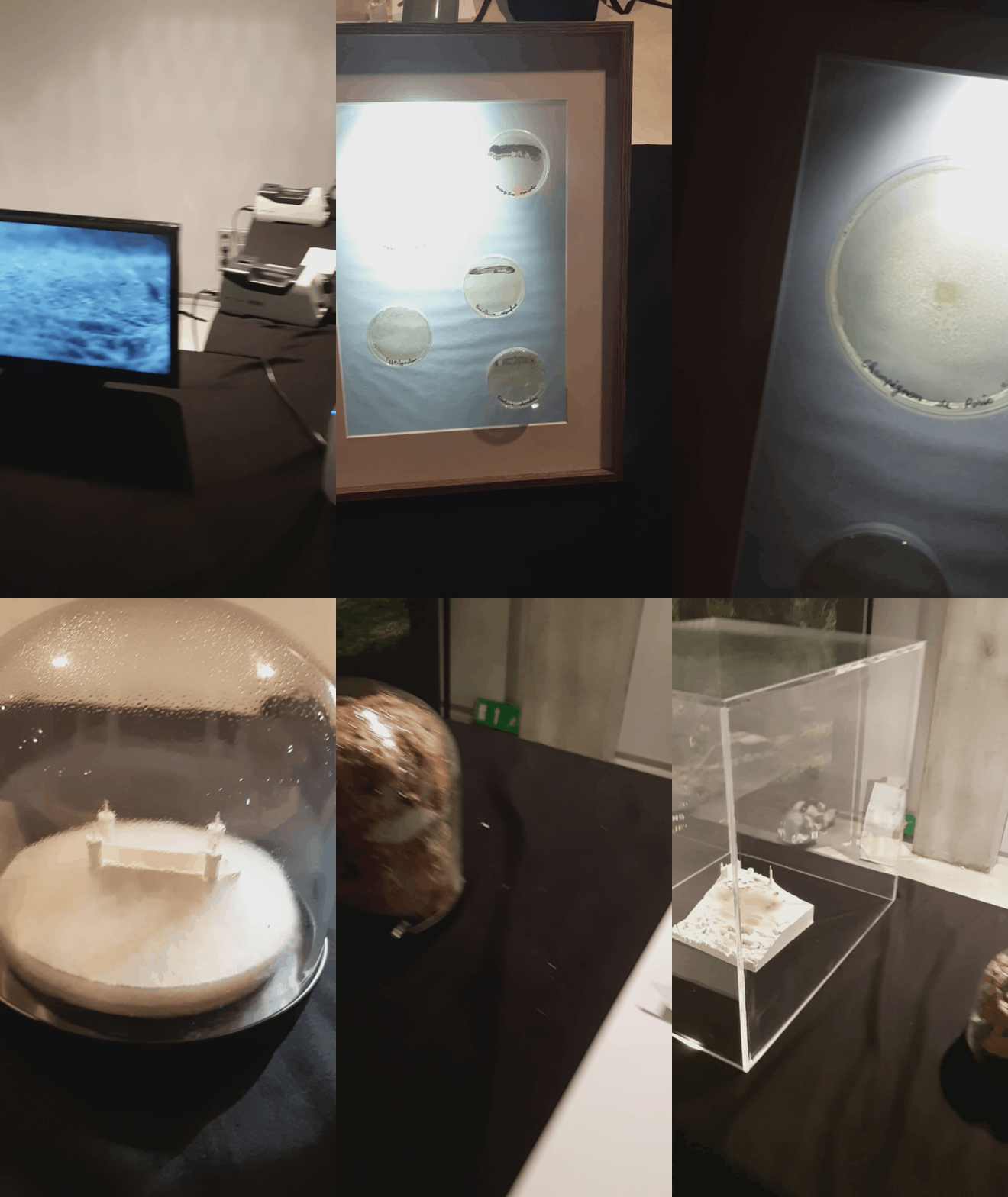
Walkthrough of the workshop.
Conclusion
Working with the Musée des Confluences to produce this event was an immense pleasure, allowing me to blend Science with artistic direction to drive an engaging story for the participant. According to the museum, 2,000 people attended the event over the weekend, and 100 participants participated in the lecture.
Aknowledgement
I thank the GFCP team for allowing me to carry out this project, particularly Nathalie Poussereau. I would also like to thank Mathias Choquer and Christophe Bruel for their participation in running the stand and Amélie De Vallée for her help in preparing the exhibition material. I also want to acknowledge Vanessa Cusimano at CNRS and Adrien Allier at Musée des Confluences, who laid the groundwork for this project and its successful organization.
The CNRS partially funded the exhibition materials.
 Adrien HAMANDJIAN